
Find detailed information regarding City St George’s student procedures and specific guidance for investigating officers, presenting officers and members of hearing committees to give an idea of what to expect if asked to take on these roles.
Tooting Campus
Addressing Sexual Misconduct in Healthcare Education
Explore 'Addressing Sexual Misconduct in Healthcare Education', co-hosted by Ioana Enany, Head of Student Conduct and Compliance at City St George's, University of London. This compelling event, featured in the Festival of Social Sciences and supported by ESRC-UKRI, examines the pressing concern of sexual misconduct in healthcare.
Gain valuable perspectives on the training gap for medical students and explore the roles of higher education institutions in addressing these critical issues.
Download the presentation (PDF)
Tips for University Sexual Misconduct Investigations
Join an expert panel of professional services staff and university academics, including Ioana Enany, City St George's Head of Student Conduct and Compliance, in this online session to learn more about investigating and conducting hearings on complaints about sexual misconduct at university.
Sexual misconduct can impede students' abilities to successfully progress through their degrees. At the same time, failing to hold those found to have violated the rules of conduct undermines the vision of a safe and fair community. In this webinar you will hear some of their advice on best practices with these challenging cases.
Available topics include:
- tips on improving investigations of sexual misconduct
- addressing issues of misunderstandings of consent with university students
- educating panel members can improve decision-making and outcomes
- advice on better processes to increase the perceptions of fairness for all parties
You can access the presentation slides here.
New Academic Integrity Procedure
A new Academic Integrity Procedure was launched at the start of the 2023/24 academic year to replace the Assessment Irregularity Procedure. As part of this change, the university created the roles of Academic Integrity Officers (AIOs).
Our Academic Integrity Officers play a crucial role in promoting and maintaining academic integrity standards within the City St George’s community. Our AIOs are advocates for academic honesty and trust. They are highly motivated, detail-oriented, and committed to promoting and upholding academic integrity standards within City St George’s. They work closely with faculty, students, professional service leads and the Student Conduct and Compliance team to educate, raise awareness, monitor, and enforce policies and procedures related to academic integrity and good academic practice.
Watch the presentation below to find out about the new procedure and process. This is particularly relevant to new AIOs.
Presentation slides (session delivered on 22 August 2023 and 4 September 2023)
Seven tips for enhancing the quality of sexual misconduct investigations
Eight ways to improve responses to sexual misconduct in universities
Introduction to City St George’s student procedures and the regulatory framework
Delivered by Dr Aileen O'Brien.
This presentation is most useful for staff looking for a general introduction to the different student procedures and includes:
- an introduction to procedural frameworks (stages, thresholds and external review)
- external stakeholders that influence procedural design
- the principles of good practise in the operation of procedures (the importance of process and student support)
- brief overview of regulations and policies which are relevant to the different procedures
- case studies – what would you do?
Session 1 presentation slides (PPT)
Mechanics of the investigation stage
Delivered by Professor Andy Kent
This presentation is most useful for staff who are currently investigating a case, or who would like more information about becoming an investigating officer. It includes:
- the role of investigating officer
- preparing for investigations
- interview techniques
- dealing with third parties and investigative complications
- mitigation and its influence on case progression
- writing a robust investigating officer report
- acting in accordance with the investigating officer protocol (PDF).
Session 2 presentation slides (PPT)
Referral to a hearing committee
Delivered by Dr Robert Nagaj.
This presentation is most suitable for presenting officers and internal and external hearing committee members. It includes:
- the role of presenting officer, on behalf of City St George’s
- preparing the City St George’s case to present to a hearing committee
- committee membership
- role of the committee members
- how to prepare for a hearing committee
- outcomes – sanctions, proportionality and justification of decision making.
Session 3 presentation slides (PPT).
- Supplementary handout (Word).
What to expect – a simulated hearing committee
A hearing committee is convened when an investigating officer recommends to the Principal of City St George’s that a case should be a hearing committee and the Principal agrees with this decision. The simulated hearing committee videos is based on the fictitious case of Mr Tom Walker, a Final Year MBBS5 student.
The investigating officer report and presenting officer case sample report (Word) provide the case history for Hearing.
We recommend these materials are read prior to watching the simulated video.
Managing reports of Sexual Assault
Information and guidance for staff members supporting students who report allegations of assault and sexual misconduct and for staff members who are acting as Investigating Officers in cases related to misconduct under the University’s procedures.
Advice for Staff Supporting Students who report Assault and Sexual Assault
Making a complaint about sexual misconduct
If a student informs a member of staff that they have been the victim of assault or sexual assault the student should be informed of the options that are available to them. These options include:
- Reporting the assault to the police;
- Self-referring to a Sexual Assault Referral Centre, where swabs and clothing can be stored as evidence for many years whilst they decide if they want to pursue a police investigation if they are unsure;
- Speaking to their GP or visiting a sexual health clinic;
- Accessing internal support from the University Counselling Service (confidential), the Students’ Union and/or a Personal Tutor.
If the student does not wish to report the incident to the police, staff members should advise any student who reports assault or sexual assault by another student or staff member of City St George’s, University of London that they can submit a formal student complaint to the Academic Registrar under the Student Concerns and Complaints Procedure. This may be particularly relevant if it has not been possible to address the concern informally.
Information on the Concerns and Complaints Procedure
Providing support to the student is of paramount importance and it is in the best interests of the student that the staff member talks through in detail the Student Concerns and Complaints Procedure prior to the student’s submission, so that the student is aware of how this will proceed and what the University’s remit is with regards to these cases. This will ensure that full transparency can be maintained between the University and the complainant and that the student feels they have been well supported in pursuing a case.
It is important that the student is informed of the differences between the Investigative boundaries of the University and a police investigation.
City St George’s Concerns and Complaints process is separate from criminal law matters, and the University’s misconduct offences are distinct from criminal offences:
University Investigation (i.e Under Formal Concerns and Complaints Procedure) | Criminal Investigation (i.e. Reporting to Police) |
The University investigation considers if there has been a breach of the Assault and Sexual Assault Policy and if misconduct as defined within the General Regulations for Students and Programme of Study (paragraph 20) has taken place | The police are responsible for investigating criminal offences. Evidence and information gathered in an investigation may be passed to the Crown Prosecution Service (CPS) to decide if the suspect should be charged with a criminal offence. |
Under its procedures, the University uses the civil standard of proof, i.e. “the balance of probabilities.” This means an independent Investigating Officer will decide whether it is more likely than not that the alleged incident occurred. | CPS will ask two questions when deciding whether to charge a suspect: 1) Is there sufficient evidence to provide a realistic prospect of conviction? 2) Is it in the public interest to prosecute? If the suspect is charged, the criminal standard of proof that must be met by the prosecution during criminal proceedings at court is that they prove the case against the defendant “beyond reasonable doubt”. |
The University cannot obtain forensic evidence. By law, CCTV footage from City St George’s campus (University and Halls of Residence) is only retainable for a short period of time. | The police can obtain forensic evidence and CCTV footage. |
The outcome of an investigation will be written into a report for the Vice-Chancellor that will determine if any further action is recommended, and whether there is sufficient evidence to refer the alleged perpetrator for consideration under the Student Disciplinary Procedure or the Procedure for Consideration of Fitness to Study and Practise. | The outcome of a criminal case is that the suspect may be found guilty or not guilty of committing a criminal offence. If they are found guilty, the court may decide to sentence the defendant right away or decide to have a separate hearing so that a pre-sentence report can be prepared. Students on clinical programmes who become the subject of a criminal investigation are required to declare this immediately (i.e. not at the end of the investigation) to the Academic Registrar and Head of Student Conduct or Compliance. |
Providing support to the respondent of an investigation:
If a report of assault or sexual assault by a student involves another City St George’s student, the Assault and Sexual Assault Policy states that there must be continuous support provided to each party:
“6.2. If there is an allegation of assault by one student against another, then SGUL will provide continuity of pastoral support, by different staff members for each student. The supporting staff member will be separate to any staff involved in any subsequent disciplinary investigation.”
You may not have the same views as the student, but you must be supportive.
This support should be organised by the Programme Team, but any difficulties arranging impartial support should be raised with the Dean for Students, the Deputy Dean for Students, or the Assistant Registrar (Student Services).
The student against whom the allegations have been made should be made aware of the allegations when they have been reported and should be informed to refrain from contact with the other party whilst the investigation is carried out. The student should be directed to the University’s support resources also, including the Counselling Service and the Students’ Union and encouraged to stay in regular contact with their designated support provider.
Meeting with students: Keeping records
Every effort should be made to encourage the student to report the incident to the University if and as soon as they feel able to. The maximum time that the student has to report the incident under the Concerns and Complaints procedure after it has occurred is 3 months. This is to prevent against degradation, loss or tainting of evidence.
When meeting with a student that has reported an assault or sexual assault, it is advisable that you inform the student that you will take notes and that you will share these with the student after the meeting. These notes may include action points, if necessary.
When taking minutes try to keep your notes clear and concise. Maintain neutral language and keep a factual record only i.e. without judgement. In addition, ensure that your notes can be understood by someone outside the University (e.g. a lawyer, family member etc) and that they cannot be open to misinterpretation.
The records that are kept by the programme team and academic staff members, and the speed of which an incident is reported will affect the currency of evidence and the perceived reliability of witnesses.
These records also provide a useful evidence trail of the support that was given to the student after their disclosure so the University can demonstrate that appropriate support was offered in line with the Assault and Sexual Assault Policy.
Advice for Staff Acting as an Investigating Officer in a case involving Sexual Assault
Reports of Sexual Assault can be reported and handled under a number of the University’s Processes, such as:
- Student Concerns and Complaints Procedure
- Student Disciplinary Procedure
- Procedure for Consideration of Fitness to Study or Practise
In addition, the Investigating Officer will need to consult the University’s Assault and Sexual Assault Policy.
The policy states:
“4.3. If a student is affected by sexual assault or assault, allegedly by another SGUL student, and the affected student decides not to report the assault to the police; the affected student may decide to discuss the assault with the University. The University will advise about how the incident would be dealt with if a University investigation of the allegation, as a potential breach of regulations under the disciplinary procedures, were carried out. Considerations for the student could include the nature of events, and how the investigative boundaries of the University contrast with those of a criminal investigation.”
“4.4. The outcome of a University investigation into the alleged assaultwill determine whether any disciplinary penalty for the alleged assailant should occur.”
Not all reports of sexual assault will be referred into the formal stage of the Student Concerns and Complaints Procedure for investigation. Often support and welfare services are more valuable to the student than the need to seek redress against the alleged perpetrator. Be mindful that it is your role as the Investigating Officer to determine, using the balance of probabilities, only whether or not ‘sexual misconduct’ has occurred, not to determine that a student has committed a criminal offence, such as rape.
Balance of probabilities
The balance of probabilities has a lower burden of proof than beyond reasonable doubt. It means that you must be satisfied that on the evidence, the occurrence of an event was more likely than not to have happened.
Succeeds | Fails |
It is more probable than not that the event occurred | The probabilities are equal or it is more probable that the event did not occur |
In preparation for your role as Investigating Officer, staff members are encouraged to read the following resources:
- Staff members should familiarise themselves with Universities UK’s guidance on How to Handle Alleged Student Misconduct Which May Also Constitute A Criminal Offence - This provides information and guidance on why and how Universities in the UK should investigate allegations of misconduct that may also constitute a criminal offence, such as assault and sexual assault. It includes examples of cases and outcomes, as well as detailed information on types of penalties and recommendations
- Against Violence and Abuse Combat Misconduct Resource Hub – This resource hub has been developed by AVA in partnership with Universities UK and the NUS. It incorporates the expertise of University staff and students to provide information, guidance and resources on sexual misconduct. This has been developed as part of the #CombatMisconduct project.
This provides information and guidance on why and how Universities in the UK should investigate allegations of misconduct that may also constitute a criminal offence, such as assault and sexual assault. It includes examples of cases and outcomes, as well as detailed information on types of penalties and recommendations.
Conducting interviews
Please refer to the Staff Training Pages and Investigating Officer Protocol for information on managing the structure of the interview.
When interviewing both the complainant and the respondent:
- Do not begin the interview until all parties are present;
- Ensure the whole meeting is recorded;
- Remain sensitive and be patient;
- Acknowledge the difficulty in disclosing sensitive information;
- Allow the student the opportunity to give their account of events;
- When constructing and asking questions for interview, do not ask leading questions;
- Ensure that the student has a dedicated support contact.
Enquire whether the student needs further support information from the University (Please contact the Dean for Students or the Deputy Dean for Students if you need further advice on this). You should as good practice in all cases, ask the support contact to touch base with the student a few days after the interview, even if the student declines further support at interview stage.
Writing the report
When writing the Investigating Officer’s Report that is submitted to the Vice-Chancellor for approval, there are a number of elements to keep in mind:
- Use neutral language, e.g. Complainant and Respondent, terminology such as “student X reported” and “student X told me that”;
- Do not elicit blame to one party;
- Do not use language or phrasing that may be considered “victim shaming”, such as referring in judgement to the amount of alcohol consumed by the complainant.
Support for Investigating Officers
If you have any questions throughout the process, please do not hesitate to contact the Student Conduct and Compliance team, the Academic Registrar or the Dean of Students.
In addition, acting as the Investigating Officer in assault or sexual assault cases can be challenging. Please do speak to a senior member of your programme team or the Dean or Deputy Dean for Students if you require more support.
Resources
There are a number of resources that staff can signpost students to. Staff should take note of the specifics of the case, if the student has disclosed this information, and consider which resources would be most beneficial in providing support to the student.
Staff acting as an Investigating Officer may also want to read through the material provided by these organisations and resources, as they can be useful for understanding how best to manage these cases sensitively.
Internal Resources: City St George's Student Union
- Welfare Handbook – information on resources in the Students’ Union and who to contact.
- The University Counselling Service – email to make an appointment.
- Sexual Abuse Support – Students' Union resource on sexual health, including support information for victims of abuse
- Rape Crisis South London / RASASC and SGUL -The service enables students to access free, non-judgemental and highly qualified support from Rape Crisis South London. It is for female and non-binary (and gender-queer) survivors of sexual abuse, sexual violence, sexual assault and rape. Students can email Steph via outreach@rasasc.org.uk.
Students who are provisionally suspended pending the outcome of a University investigation are still able to access support from the Students’ Union and the University Counselling Service. Students will be advised if they will need to make prior arrangements for appointments (i.e. they might need to advise the Student Conduct and Compliance Team when they need to be on-site so that Security can be alerted to this). Please note that all suspension arrangements are co-ordinated by Student Conduct and Compliance and students need written permission to temporarily attend site.
External resources
- Rape and Sexual Abuse Support Centre South London – Support resource for sexual assault and abuse victims, including counselling in South London and a free national helpline.
- Refuge – support for those who have experienced violence and abuse, including sexual violence. Resources include a free 24hour national helpline, emergency temporary accommodation, community support. Refuge also offers culturally-specific support services and support for children.
- Survivors UK is a male and non-binary sexual violence support agency for those who have been affected by rape or sexual abuse. There is a webchat and SMS service option to contact them and they emphasise that you can share information at your own pace.
- Galop supports LGBT+ people who have experienced sexual abuse and violence. Their website includes contact details for the National LGBT+ Domestic Abuse Helpline, the LGBT+ Hate Crime Helpline and the National Conversion Therapy Helpline. You can also self-refer to their services and they can also offer referrals or signposting to specialist or local LGBT+ services and organisations.
- The Survivors Trust – this trust has 120 member organisations that provide specialist support for men, women and children who are victims of sexual violence and abuse. By putting in your postcode you can find specialist support in your area.
- Women's Aid – Information on getting help if you think you might be in an abusive relationship, including a live chat and email option. Forums for speaking to a supportive community of abuse survivors and a handbook for help on all aspects of domestic abuse, including housing and dealing with the police.
- List of Sexual Assault Referral Centres in the UK – NHS website that allows you to search your postcode or town to find Rape and Sexual Assault Referral Centres near you. At a SARC, swabs and clothing can be stored as evidence for many years whilst the service user considers if they want to pursue a police investigation.
- The Havens – specialist centres in London for people who have been raped or sexually assaulted. There are three locations in Camberwell, Whitechapel and Paddington, which cover the whole of London. You can make an appointment at the location of your choice using the contact details on their website.
- Rights of Women, Booklet: From report to court: a handbook for adult survivors of sexual violence - this booklet contains detailed information on the journey that a person who reports sexual assault to the police would undertake, including information on the legal process from the point of reporting it to the police through to sentencing after a court case has finished.
- Responding to Disclosures of gender based violence is a pre-reading document that the Students’ Union received from AVA designed to assist in responding to student disclosures
If staff have any concerns or questions regarding the options or process for reporting assault and sexual assault to the University they can contact the Student Conduct and Compliance Team.
Academic Procedure Resources for Staff
Mitigating Circumstances, Provisional Appeals, and Formal Academic Appeals
Delivered by Miss Frances Stannard, Student Conduct and Compliance Officer.
This presentation covers the grounds for submitting formal academic appeals and explains how mitigating circumstances processes, provisional appeals and formal academic appeals all link together.
Discretionary panel procedure training
Delivered by Miss Frances Stannard, Student Conduct and Compliance Officer.
- Discretionary Panel Training for Staff (Panopto).
This presentation provides an overview of Discretionary Panels and their purpose, clarifies the associated timeframes and the planning process, and summarises the options available to students if they are dissatisfied by the Discretionary Panel decision.
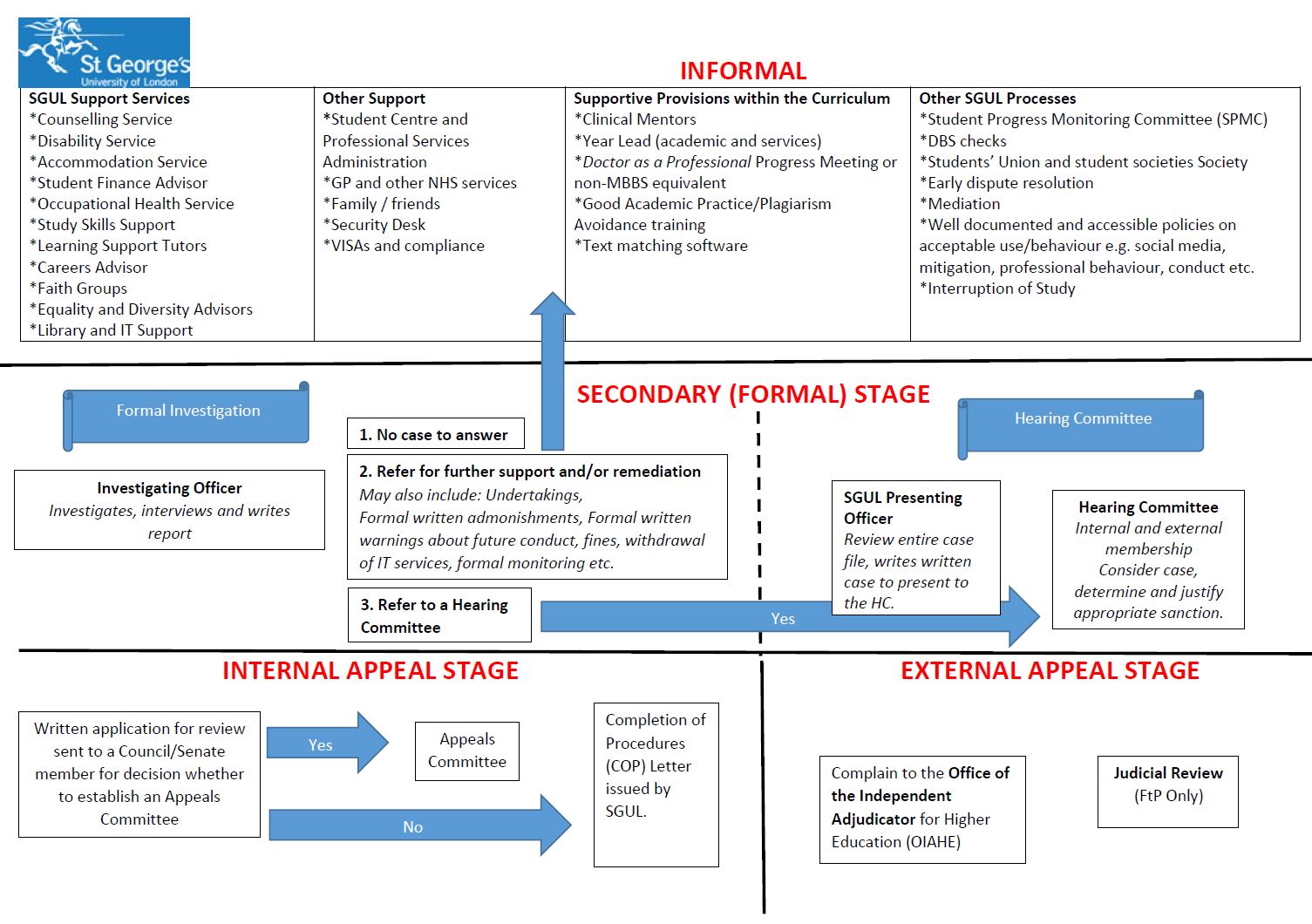
Overview diagram
The diagram below provides an overview of how the various roles described within the presentations map onto the Student Procedures that you may have been asked to act under.
DBS Information for Staff
Repository for information to help train staff responsible for various aspects of City St George’s DBS process.
Useful websites
Disclosure and Barring Service
Disclosure and Barring Service website.
The Disclosure and Barring Service (DBS) was established in 2012 and carries out the functions previously undertaken by the Criminal Records Bureau (CRB) and the Independent Safeguarding Authority (ISA).
GBG Online Disclosures
GBG Online Disclosures website
GBG is an umbrella body for the Disclosure and Barring Service (DBS). The criminal record checking process helps employers make safer recruitment decisions, enabling them to undertake appropriate checks on students who may come into contact with children and vulnerable groups. Eligibility for disclosures is underpinned by law. The level of the check required is dependent on the exposure and risk associated with the relationship between the individual and the children and/or vulnerable groups.
GBG provides expert advice and guidance on the regulated activity guidance and eligibility criteria to ensure all checks are legal and proportionate.
GBG have developed Online Disclosures, an online criminal record check application utilising the DBS’s e-Bulk interface, which allows electronic submission of criminal record check applications without the need to fill in a paper application form. It’s a faster, cost effective and more efficient process than paper-based applications. Our online application has been developed to take all the stress and hassle out of the process, enabling you to focus on your core activities.
There are three types of disclosure: basic, standard and enhanced.
Enhanced checksare for roles that involve regular care, supervision or training for children and vulnerable adults. The enhanced check involves an additional level of check above the Standard check – a check on local police records. Where local police records contain additional information that may be relevant to the post the applicant is being considered for, the Chief Officer of police may release information for inclusion in an enhanced check. All City St George’s checks are enhanced for students who study on clinical programmes.
All persons applying to study on medical and healthcare programmes are required to undertake an enhanced-level Disclosure and Barring Service (DBS) check and must pass this check prior to enrolment.
City St George’s uses GBG Online Disclosures to undertake an online criminal record check. All City St George’s ID checks are done via an external document certification service at the Post Office. Once the DBS check has been completed, students will receive an original DBS certificate. Students must retain the original DBS certificate. It is the only copy and replacement certificates cannot be issued.
Contact GBG Online Disclosures support team via email or phone 0845 251 5000 (Monday-Friday 8.30am-5.30pm).
Post Office document certification service
Document certification service (Post Office)
All City St George’s ID checks are done via an external validation service (ie the Post Office). Performing checks in-house carries a high level of responsibility and risk for individuals which is why our processes do not allow member of City St George’s staff to perform checks.
A Post Office ID check costs £10.50 which must be paid in cash at the Post Office.
The Online Disclosure and Barring Service (DBS) ‘Update Service’
DBS Update Service: employer guide.
All new students must register for the Update Servicewithin 30 days of the DBS certificate being issued and must ensure that they pay the annual subscription fee.
Student registration costs £13 per year (payable by debit or credit card only). Students can register for the Update Service using their e-reference number or DBS certificate number. They must do this within 30 days of the certificate being issued and must make sure they pay the annual subscription fee. If students do not renew their subscription before it ends, they will need to apply for a new DBS check and register for the Update Service again. If a student joins with their e-reference number, the application must be received by the DBS within 28 days (not 30) of the subscription being created, or the subscription will fail.
The Update Service allows:
- applicants to keep their DBS certificates up to date
- employers to check a DBS certificate.
Staff can check a student’s criminal record status on the Update Service if:
- the employer has the individual’s consent
- the employer could legally request a new DBS check for the role that the individual is applying for
- it is for the same workforce, where the same type and level of criminal record check is required.
Students who are required to attend clinical placements as part of their course can use their original DBS certificate (from when they joined City St George’s) alongside the Update Service to take their certificate with them from role to role (if within the same workforce, ie on a City St George’s clinical placement).
There are legal requirements for staff checking the Update Service. The employer guide also contains information about how to interpret check results.
Before carrying out a status check, you must be able to answer ‘yes’ to the following questions. If you answer ‘no’ then you cannot carry out a status check:
- Have you seen the applicant’s original certificate?
- Have you checked the applicant’s ID to confirm their identity?
- Do you have the applicant’s consent?
- Are you legally entitled to the same level of DBS certificate – enhanced?
- Does the DBS certificate only contain the exact workforce that you are entitled to know about, for the role you are recruiting for?
Internal Resources
DBS Enquiries
Line managers are responsible for ensuring new staff are inducted in DBS processes.
For compliance purposes, every member of staff is responsible for ensuring that they keep up-to-date with changes to DBS legislation and regulation.
The Students Records Team will be informed by SC&C to amend a student record status where the student has made a SITS re-enrolment DBS disclosure in error.
Managing DBS Enquiries
Please note that emails to the DBS Enquiries mailbox now receive an automated response as it is no longer monitored- all relevant information is below | |
Questions about/requests for GBG pins, passcodes and the Update Service – for applicants and students in Year 1. | Admissions Team Visa Compliance Officer for all International Students |
Questions about/requests for GBG pins, passcodes from students in Year 2 onwards (all courses – but does not include international students, who are managed by the Visa Compliance Officer) who have failed to pay the yearly subscription for the Update Service and now need to apply for a new DBS Check. | Assistant Registrar (Student Services) or Student Centre Advisor |
Questions about/requests for GBG pins, passcodes from students in Year 2 onwards who have a change in criminal record status. | SC&C Team |
Responding to emails where students disclose a change in criminal record status or ongoing police investigation (mid-year). | Automated response directing students to SC&C Team |
Responding to emails generated by SITS where students disclose a change in criminal record status during online-re-enrolment. | SC&C Team |
Questions about how students can access the Update Service for clinical placements. | Information on automated response or Student Life Centre |
Questions about how students can access the Update Service for Final Year MBBS Electives. | MBBS Final Year Administrator |
Requests for a letter of good standing for MBBS Final Year Electives (where permitted by external organisation). | MBBS Final Year Administrator Please note: City St George’s is phasing out ‘letters of good standing’ following the introduction of the Update Service. No letters of good standing should be issued after the end of 2019. |
Queries about DBS checks / Update Service for volunteering or for any job. | To be re-directed to the SU, Head of WP or to the future employer. St George’s has no responsibility. |
Processing international student DBS checks via GBG following receipt of in-country police check (Fresher’s Week Induction until return of DBS certificate) | Visa Compliance Officer |
Convening DBS panels for applicants and continuing students with criminal records and communicating DBS panel outcomes to students / course teams /admissions | SC&C Team |
Download:
Advice on responding to emails and email templates (Word)
When using email templates, please ensure you provide the correct pin and passcode (these are course specific).
Checking the progress or outcome of a student DBS check
The Chief Operating Officer (COO) is the institutional owner (Level 1) of City St George’s GBG Online Disclosure account (Word).
Staff who require access to GBG Online Disclosures in order to process student DBS checks will be allocated access by the Assistant Registrar (Admissions).
What information does City St George’s give to students and applicants about DBS processes?
- See Criminal record disclosure panels (DBS) for information on DBS checking and disclosure of criminal convictions for both applicants and continuing students.
- New admissions process for 2019 DBS screening (Word)
- Admissions FAQs on DBS and other self-disclosures for applicants (Word)
Allocation of other staff responsibilities
Task | Owner |
Setting new staff up on GBG Disclosures and allocating permission levels (Level 2, 3 or 4) | Assistant Registrar (Admissions) Sarah De Gatacre |
Gaining access to DBS Enquiries inbox | Assistant Registrar (Admissions) or Head of SC&C |
Training staff in DBS process, legal requirements / keeping up to date with DBS changes | Academic Registrar and Line Managers |
Merging City and St George’s Resources
As we bring together resources for City (Clerkenwell) and St George’s (Tooting) students, some content may be specific to one campus and not the other. For the most relevant information, try using specific keywords or exploring content related to your department. If you need help, our support teams are available to guide you.
Clerkenwell students can contact campus.news@citystgeorges.ac.uk
Tooting students can contact studentlifecentre@sgul.ac.uk.